
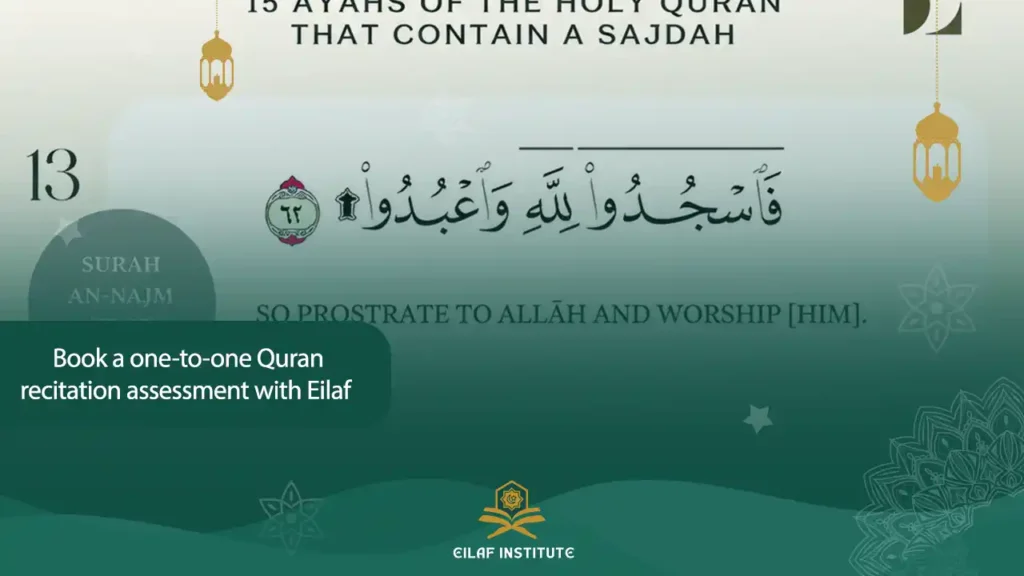
Quran sajdah verses are specific passages in the Holy Quran where both the reciter and attentive listener are encouraged or required to perform a single act of prostration upon reading or hearing them. These designated verses highlight the majesty of the Creator, recount moments when earlier prophets fell into humble prostration, or contain explicit divine commands to bow before Allah.
What is Sajdah al-Tilawah?
Sajdah al-Tilawah refers to the single prostration performed upon encountering one of the prostration verses during Quran recitation, whether in formal prayer (Salah) or outside it. It is an act of devotion prompted by the specific thematic content of the verse being recited.
Spiritual Purpose and Origin
The primary purpose of this prostration is physical obedience and recognition of divine sovereignty. When a believer reads a verse describing how the heavens, the earth, and the angels prostrate to Allah, or when reading a challenge issued to the arrogant who refuse to bow, the reciter immediately prostrates to separate themselves from disobedience.
Authentic hadith literature reports that when the son of Adam recites a sajdah verse and prostrates, Satan withdraws in tears, lamenting that man was commanded to prostrate and obeyed, earning Paradise, whereas he was commanded to prostrate and disobeyed, earning the Fire.
Quran sajdah verses: How many sajdah verses are in the Quran?
There are either 14 or 15 Quran sajdah verses depending on the school of Islamic jurisprudence (madhhab) you follow. While the majority of scholars acknowledge 15 places where prostration is practiced or commended, differences in legal classification account for the variance between regional traditions.
Understanding the Scholarly Difference (14 vs. 15)
The question of how many sajdahs in Quran copies exist centers primarily on Surah Al-Hajj and Surah Sad:
- The Hanafi School recognizes 14 prostrations. They do not count the second prostration in Surah Al-Hajj (verse 77) as a command for the bowings of prayer, but rather as an independent sajdah tilawah. They consider Surah Sad (verse 24) a confirmed sajdah of recitation.
- The Shafi’i and Hanbali Schools: Recognize 14 or 15 positions, maintaining that Surah Al-Hajj has two distinct prostrations based on explicit hadith narrations, while viewing Surah Sad (verse 24) primarily as a “Sajdah Shukr” (prostration of gratitude) performed by Prophet Dawud (AS), though still commendable to perform.
- The Maliki School lists 11 agreed-upon verses, excluding the three shorter Surahs near the end of the Quran (Al-Najm, Al-Inshiqaq, and Al-Alaq), as they categorized them as abrogated in their regional practice, although the broader consensus retains them.
How Sajdah Symbols Appear in the Mushaf
Printed copies of the Quran employ distinct sajdah symbols to notify the reader:
- A Horizontal Line: Placed directly over the word indicating the physical act of prostration or divine command.
- A Marginal Dome Icon: A miniature representation of a mosque dome or mihrab printed in the margin adjacent to the line.
- Arabic Inscription: The word Sajdah (سجدة) is printed clearly in the margin along with the verse number.
Complete reference list
The 15 recognized verses span both early Meccan and later Medinan revelations. Below is the full chronological record in order of the Quranic arrangement:
Read also about: What Do Muslims Say In Sujood?
What to do when reading one?
When your recitation reaches the marked word, you pause, complete the sentence or verse to retain proper linguistic context, and descend into a single prostration.
Step-by-Step Procedure for the Prostration
- Intention (Niyyah): Form the intention in your heart to perform Sajdah al-Tilawah.
- Takbir (Allahu Akbar): It is recommended to utter Takbir while moving downward into prostration. Starting from a standing position is ideal if convenient, but descending directly from a sitting posture is completely valid.
- The Position: Place forehead, nose, both palms, both knees, and the toes of both feet flat on the ground, identical to normal prayer posture.
- Supplication: Recite standard praises or the specific Quranic supplication.
- Rising: Say Takbir as you lift your head back to a sitting or standing position. A formal Salam (Tasleem) is required according to the Shafi’i and Hanbali schools, while the Hanafi school regards it as unnecessary outside of prayer.
Know more about: Dua For Sajdah In Quran
Rules for listeners and women
The obligation or recommendation of prostration extends beyond the actual reciter to those who hear the verse, provided certain conditions of intent and presence are met.
Active Listeners vs. Passive Hearers
Islamic jurisprudence distinguishes between someone deliberately listening (Mustami’) and someone merely passing by or hearing background sound (Sami’):
- The Active Listener: If you intentionally sit down to listen to a reciter or live class, you follow the reciter into prostration.
- The Passive Hearer: If Quranic audio plays in another room or you overhear someone reading while you work, prostration is entirely optional and not expected.
- Recorded Audio: Contemporary scholars note that listening to pre-recorded digital media does not mandate a prostration, because the source is not a living reciter actively performing the rite in real time.
Specific Guidelines for Women
Women practicing recitation encounter specific situations involving dress codes and ritual states:
- Covering and Hijab: The majority of classical jurists require full Islamic attire, including the hijab, matching prayer requirements. However, scholars like Ibn Taymiyyah and contemporary jurists argue that because it is an isolated act of veneration rather than formal prayer, wearing a headscarf is recommended rather than strictly mandatory if reciting at home.
- During Menses: Women undergoing menstruation who recite the Quran from memory or touch digital screens without touching a physical Mushaf do not perform the physical prostration, as ritual purification is absent. They may instead utter words of remembrance (Dhikr).
Common questions and differences of opinion about Quran sajdah verses
Scholarly debates on this topic revolve primarily around whether this act is mandatory (Wajib) or voluntary (Sunnah), as well as the necessity of formal ritual cleanliness.
Prerequisites: Wudu, Qibla, and Delaying the Sajdah
- State of Wudu: The four established Sunni schools consider ritual purity (Wudu) a non-negotiable prerequisite, matching the rules of regular prayer. A minority opinion, famously supported by Abdullah ibn Umar, Ibn Hazm, and Al-Bukhari, allows prostrating without Wudu if one is caught unprepared, prioritizing immediate physical submission.
- Facing the Qibla: Standard consensus dictates facing Makkah unless one is traveling in a moving vehicle where turning is physically unfeasible.
- Immediate vs. Delayed Action: Prostrating immediately upon finishing the verse is the authentic Sunnah. If you are driving, teaching, or unable to stop, you may complete your recitation and perform the prostration as soon as a clean, suitable place becomes available.
Enroll now in our beginner Quran classes to learn how to recite and perform Sajdah verses!
Recite with confidence: join our Quran recitation with Tajweed course.
Frequently Asked Questions
How many sajdahs are in the Quran?
Standard modern Mushafs mark 15 verses of prostration. The Hanafi legal school officially observes 14 of these instances, while the Shafi’i, Hanbali, and standard international prints account for all 15.
Is prostration obligatory?
According to the Hanafi school, it is Wajib (obligatory). According to the Shafi’i, Maliki, and Hanbali schools, it is an emphasized voluntary Sunnah, meaning the believer receives immense reward for doing it, but incurs no sin for omitting it.
Do I need wudu for Sajdah Tilawah?
The vast majority of traditional jurists require Wudu, clean clothes, and facing the Qibla just like regular prayer. However, certain notable classical scholars held that Wudu is not strictly mandatory for reading-based prostrations outside of formal prayer.
What symbol marks a sajdah verse?
In printed Arabic copies of the Quran, a sajdah verse is marked by a solid horizontal line printed directly above the operative word of prostration, paired with a miniature dome or arch symbol in the margin containing the word Sajdah.