
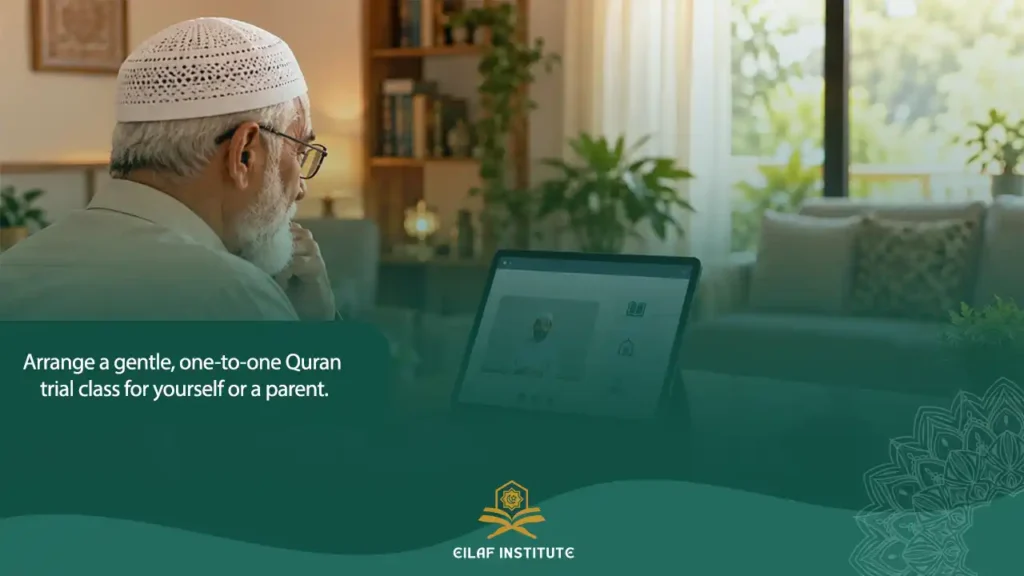
Online Quran classes for seniors offer a specialized, dignified pathway for older adults to learn, refine, and connect with the Book of Allah from the comfort of home. Many seniors spent their working years focusing on family and career obligations, leaving little time for deep, structured Quranic study. Later in life, returning to religious learning can feel daunting, especially if one fears being judged for slow progress or technical difficulties. Through gentle, one-on-one virtual instruction, older learners receive the patient guidance, customized pacing, and accessibility adjustments they need to fulfill their spiritual goals with absolute confidence.
Learning goals for older adults
Learning goals for older students focus on spiritual peace, correcting recitation for daily prayers, understanding verse meanings, and modest memorization rather than rapid academic advancement.
Unlike younger students pursuing intensive certification or full Hifz, seniors approach the Quran as an act of heartfelt devotion and personal fulfillment.
Perfecting Daily Prayer Recitation (Salah)
The primary objective for many older Muslims is ensuring their daily prayers are valid and beautiful.
- Surah Al-Fatiha Mastery: Ensuring this pillar of prayer is pronounced with accurate vowels and letters.
- Short Surah Refinement: Correcting lifelong pronunciation habits in the concluding chapters of the Quran (Juz Amma).
- Correcting Tashkeel (Vowel Marks): Eliminating accidental slips in short vowels (Fatha, Kasra, Damma) that might alter the intended meaning of verses recited in Salah.
Deepening Spiritual Reflection and Peace
Older adults frequently seek an emotional bond with the Quran rather than rote repetition.
- Understanding Core Themes: Taking time during lessons to discuss the general meaning and comfort offered by specific verses.
- Reflective Recitation: Moving at an unhurried tempo that allows the heart to absorb the divine message.
- Daily Routine Anchor: Transforming the Quran lesson into an anticipated spiritual anchor that brings calm and structure to the week.
Learning from Scratch Without Social Pressure
Many older Muslims never had the opportunity to learn Arabic script in childhood. Enrolling in an adult beginner Quran program allows seniors to start from the alphabet in total privacy, completely free from the embarrassment often felt in public mosque classrooms.
Accessibility and pacing needs
Teaching older adults requires thoughtful adjustments for vision changes, hearing sensitivities, vocal stamina, and information processing speed.
Large Fonts and High-Contrast Visuals
Standard printed copies of the Quran can strain aging eyes, leading to headaches and fatigue.
- Digital Zoom Capabilities: Online platforms allow instructors to display large-print, high-contrast digital Mushafs where verses are enlarged significantly on the screen.
- Color-Coded Tajweed Fonts: Using distinct colors for vowel marks and recitation rules makes it easy for students with diminished eyesight to navigate the text.
- One-Verse Display: Isolating single verses or individual lines prevents visual crowding and keeps the student's eyes relaxed.
Managing Hearing and Articulation Fatigue
Changes in hearing require teachers to articulate consonants with deliberate volume, resonance, and visual clarity.
- Lip Reading and Visual Cues: Instructors keep their cameras positioned close to their faces, allowing the senior student to observe lip and tongue placement for difficult letters.
- Noise-Canceling Audio: Clear microphones ensure the student hears subtle phonetic differences without distracting background interference.
- Vocal Rest Breaks: Older vocal cords tire more quickly; lessons incorporate brief pauses between recitations to prevent throat strain.
The Philosophy of Slow-Paced Quran Learning
Slow paced Quran learning respects the biological realities of memory consolidation in older age. Rather than rushing through an entire page in a single sitting, an instructor may spend an entire thirty-minute session perfecting two or three verses, repeating them with warmth and reassurance until the student feels completely secure.
Reading, Tajweed and memorization options
Curricula designed for senior Muslim classes are modular, allowing learners to select the exact area of focus that matches their current ability and energy levels.
Foundational Reading for Complete Beginners
For seniors who cannot read Arabic script, instruction begins with modern phonics primers like Noorani Qaida.
- Single Letter Identification: Learning to distinguish letters by their base shapes and dot counts.
- Joining Letters: Understanding how letters attach at the beginning, middle, and end of words.
- Vowel Mechanics: Moving step by step from short vowels to long vowels without memorizing complex grammatical theory.
Essential Tajweed for Accurate Recitation
Seniors do not need to memorize classical poetic texts on Tajweed; they simply need applied, practical rules.
- Distinguishing Similar Letters: Training the tongue to separate light letters from heavy letters, such as Ta versus Twa.
- Mastering the Bouncing Letters (Qalqalah): Adding rhythmic clarity to stops in short surahs.
- Nasalization (Ghunnah): Holding the nasal hum on doubled Noon and Meem for a soothing, measured cadence.
Low-Pressure Memorization of Daily Surahs
Memorization for seniors focuses on high-reward, comforting passages rather than large volumes.
- Surah Yasin and Surah Al-Mulk: Cherished chapters often memorized verse by verse over several months.
- Ayat al-Kursi and Surah Al-Baqarah's Final Verses: Key passages recited for protection and evening remembrance.
- Zero-Pressure Testing: Review sessions are conducted collaboratively, where the teacher prompts gently whenever memory falters.
Technology setup made simple
Setting up Quran lessons for elderly students requires a minimalist technical approach that eliminates confusing menus, passwords, and multi-step logins.
Equipment / Tool | Recommendation for Seniors | Key Advantage |
|---|---|---|
Device | Tablet (iPad) or Laptop (15″+ screen) | Large visual display; stable stand on a table. |
Audio | Over-ear padded headset with microphone | Eliminates room echo; delivers clear, loud sound. |
Platform | Zoom or Google Meet with recurring link | Single-click entry; no login password required daily. |
Desk Setup | Well-lit room with supportive chair | Prevents neck strain and maintains comfortable posture. |
Steps to Simplify the Experience for Family Members
Family members can prepare a foolproof setup with three simple steps:
- Create a desktop shortcut or tablet home-screen icon that links directly to the recurring classroom link.
- Set the computer volume to a comfortable default level and lock the screen resolution to large text mode.
- Place the tablet or laptop on a sturdy reading stand at eye level so the student does not have to hunch forward.
Online Quran classes for seniors: How one-to-one lessons work?
One-to-one sessions pair the senior student with an empathetic mentor who adapts every minute of the lesson to the student's mood, physical stamina, and comprehension rate.
Structure of a Gentle 30-Minute Session
A well-paced thirty-minute lesson balances friendly check-ins with focused, relaxed practice:
- Minutes 1–5: Warm Greeting and Centering: A friendly conversation to ease into the lesson and recite opening prayers (Dua).
- Minutes 6–15: Review of Previous Verses: Reciting the previously studied lines with gentle corrections from the tutor.
- Minutes 16–25: New Verse Introduction: The teacher recites a new line several times; the student repeats it line by line while observing digital screen highlights.
- Minutes 26–30: Encouraging Wrap-Up: A concluding recitation together, celebrating the day's progress and setting a simple, stress-free review goal for the next class.
Private Learning Eliminates Classroom Anxiety
In group madrasahs, older learners often feel self-conscious when younger students learn faster or when they have to ask a teacher to repeat a sentence multiple times. Private Online Classes Of Quran provide complete emotional safety: the teacher's sole focus is on that single senior student, welcoming repeated questions with warmth and patience.
Choosing the right schedule and teacher
Selecting the right program requires matching class times to the senior's peak alertness hours and choosing an instructor trained specifically in adult education.
Matching Energy Peaks
Older adults generally experience their highest mental clarity and physical energy in the morning or early afternoon.
- Post-Fajr or Mid-Morning: An ideal window when the house is quiet and energy is fresh.
- Avoiding Late Evenings: Late afternoon and evening sessions often lead to eye strain, drowsiness, and reduced retention.
- Consistent Days: Booking classes on fixed days (such as Monday and Thursday mornings) builds a comforting, dependable weekly rhythm.
Gender Preferences and Female Tutors
Comfort and cultural modesty are essential for older students. Many senior women feel far more at ease reading with a dedicated female instructor. High-quality academies provide specialized Online Quran Classes for Female elders, pairing them with mature, certified female teachers who foster a sisterly, supportive learning environment.
Qualities of a Dedicated Senior Quran Instructor
When evaluating teachers, ensure the instructor possesses:
- Unwavering Patience: Never displays irritation, sighs, or rushes the student through a word.
- Clear, Articulate Speech: Speaks loudly, clearly, and without thick background accents that make comprehension difficult.
- Respect for Life Experience: Treats the senior student with deep Islamic honor (Adab), recognizing them as an esteemed elder of the community.
FAQ
Can seniors learn Quran online?
Yes, seniors can learn Quran online with tremendous success. The availability of large digital screens, comfortable home environments, and one-on-one personalized pacing makes online learning far more accessible and comfortable for older adults than traveling to a physical classroom.
Are classes suitable for complete beginners?
Yes. Classes are specifically tailored for adults starting from zero. Tutors begin with single Arabic letter recognition using gentle, visual primers and progress only when the student feels completely confident.
How long should each lesson be?
The recommended duration for senior students is thirty minutes per session, two to three times per week. Thirty minutes provides ample time for meaningful practice without causing mental fatigue, voice strain, or eye exhaustion.
Can tutors support poor eyesight or hearing?
Yes. Tutors utilize digital screen-sharing to zoom in on words, adjust high-contrast color settings, and wear high-definition microphones. They articulate words slowly with visible mouth movements, allowing students with mild hearing or vision loss to follow along comfortably.