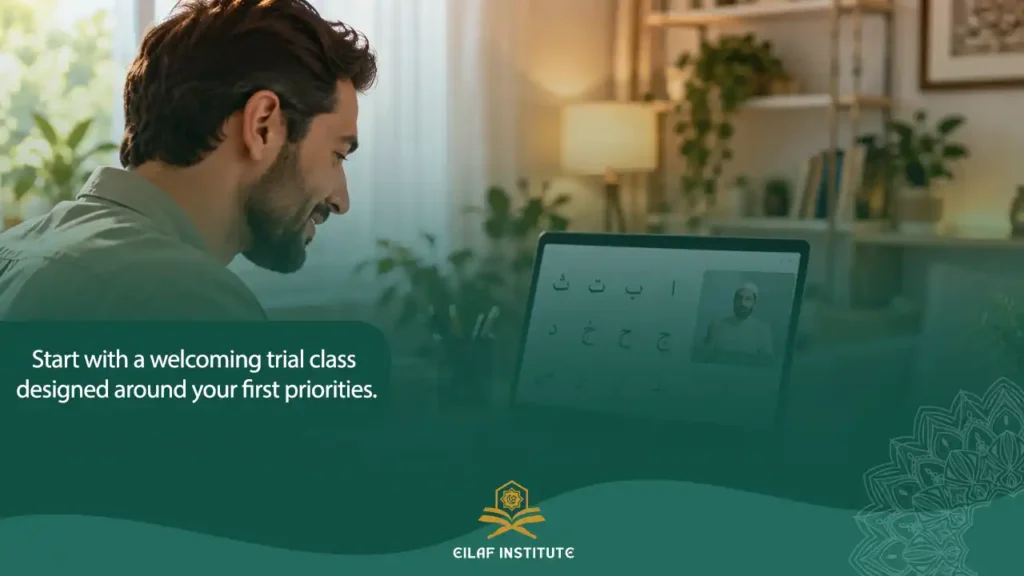
Online Quran classes for new Muslims offer a welcoming way to learn the Quran without feeling overwhelmed by the many new skills involved. For someone who has recently embraced Islam, learning how to read Arabic, pronounce Quranic letters, memorize short surahs, and understand the basics of prayer can feel like a lot to manage at once.
Having a dedicated teacher provides clear guidance and allows each learner to progress according to their own abilities. One-on-one online lessons also create a comfortable space where new Muslims can ask questions, practice freely, correct mistakes, and gradually become more confident in their Quran reading and Islamic practice.
Online Quran classes for new Muslims: Where they should begin
New Muslims should begin their studies through two parallel tracks: learning Surah Al-Fatihah phonetically for immediate use in daily prayer (Salah), while simultaneously studying the Arabic alphabet to build long-term reading literacy from the ground up.
Separating immediate prayer needs from long-term reading development prevents the anxiety that often stalls a new convert's progress.
Arabic alphabet and Al-Fatihah
Surah Al-Fatihah is the foundational chapter of the Quran and an essential pillar of the five daily prayers. Because a convert needs to pray immediately, waiting months to learn the alphabet before touching Al-Fatihah is impractical.
The Auditory Bridge for Al-Fatihah:
In the first few weeks of Quran lessons for converts, tutors teach Al-Fatihah line by line using auditory repetition. The teacher recites a short phrase, and the student repeats it, focusing on rhythm and clear sounds. English transliteration serves as a temporary crutch during this initial phase so the student can fulfill their daily prayers with peace of mind.
Studying Arabic Letters for New Muslims:
While memorizing Al-Fatihah by ear, the student begins learning the twenty-eight consonants of the Arabic script using introductory primers like Noorani Qaida. This tracks parallel progress: the heart and tongue participate in worship immediately, while the mind begins the systematic work of decoding letters, vowels, and word connections.
A realistic first 12 weeks
A structured three-month plan keeps expectations grounded, dividing foundational literacy into manageable, achievable steps.
Weeks 1–4 (The Essentials):
- Memorize Surah Al-Fatihah through guided audio repetition.
- Learn the mechanics of physical purification (Wudu) and basic prayer postures.
- Master the visual shapes and sounds of the first fourteen letters of the alphabet.
Weeks 5–8 (Completing the Alphabet):
- Complete the remaining fourteen letters of the alphabet.
- Introduce the three short vowels: Fatha (short "a"), Kasra (short "i"), and Damma (short "u").
- Memorize Surah Al-Ikhlas by ear for use as a second surah in prayer.
Weeks 9–12 (Early Word Reading):
- Practice how letters connect at the beginning, middle, and end of words.
- Read simple, three-letter vowelled words step by step.
- Memorize Surah Al-Falaq and Surah An-Nas to complete the fundamental set of protective prayers.
Quran reading vs Islamic studies
Quran reading focuses strictly on phonetic decoding and recitation accuracy, whereas Islamic studies provides the theological understanding, legal guidance, and spiritual context required to live as a practicing Muslim.
Both areas are vital, but trying to bundle them into a single lesson without a clear structure creates cognitive fatigue. Balanced programs for beginner Quran for reverts divide study time intentionally between technical reading and essential religious education.
Area of Study | Core Subjects Covered | Primary Practical Outcome |
|---|---|---|
Quran Reading | Alphabet, vowels, letter connections, basic Tajweed rules | Reading the Arabic script independently and accurately |
Islamic Basics | Aqeedah (Belief in One God), Fiqh of prayer, fasting, Halal/Haram food, Seerah (Prophet’s life) | Confidently practicing daily worship and understanding the wisdom behind Islamic laws |
Choosing a supportive tutor
Selecting the right instructor requires prioritizing cross-cultural empathy, native or fluent English communication, and specialized experience working with adult converts.
Teaching an adult who embraced Islam yesterday is entirely different from teaching a child raised in an Arabic-speaking household. Tutors must possess specific pedagogical and emotional skills:
A Zero-Shame Policy:
Adult converts often feel embarrassed when their vocal cords struggle with unique Arabic consonants like 'Ayn or Ha. A great tutor normalizes mistakes, celebrating effort and reminding the student that the Prophet (PBUH) stated that one who struggles while reading receives a double reward.
Fluent, Nuanced English:
The instructor must explain concepts without heavy linguistic barriers, ensuring that explanations of prayer rules or pronunciation mechanics are instantly clear.
Cultural Sensitivity:
Tutors must understand the social adjustments converts navigate, such as family dynamics, workplace boundaries, and dietary changes, offering compassionate advice rather than rigid demands.
Privacy and Gender Preference:
Many revert sisters specifically require female teachers for comfort and modesty, making dedicated one-to-one private settings essential for their peace of mind.
Mistakes and overwhelm to avoid
New Muslims frequently encounter burnout by attempting to absorb centuries of Islamic scholarship in their first few months of conversion. Recognizing these common traps helps protect your spiritual well-being.
The "Firehose" Trap:
Trying to learn Arabic grammar, memorize five chapters, read extensive Hadith collections, and alter every daily habit all at once leads to exhaustion. Islam was revealed gradually over twenty-three years; give yourself permission to grow gradually.
Long-Term Transliteration Dependence:
While English phonetic spellings are helpful for the first few weeks of prayer, relying on them indefinitely causes serious pronunciation errors. English letters cannot capture throat-based Arabic letters, leading to distorted meanings. Transition to the Arabic alphabet as early as possible.
Perfection Paralysis in Prayer:
Many new converts avoid praying because they fear their recitation is not yet flawless. In Islamic jurisprudence, sincere effort fulfills your obligation while you are learning. Pray with what you know, even if it is simply repeating phrases of remembrance (Dhikr) while following the movements.
Studying in Complete Isolation:
Relying solely on automated apps or pre-recorded videos leaves you without feedback or moral support. A live teacher provides accountability, immediate phonetic correction, and a personal human anchor in the Muslim community.
FAQ
Can a new Muslim learn Quran without Arabic?
A new Muslim can read translations to understand the message immediately in their native language, but reciting the Quran in worship requires the original Arabic text. With structured, slow-paced guidance, learning to read the Arabic alphabet takes only a few weeks of consistent practice.
What should a convert learn first?
A convert should prioritize learning the physical movements of the five daily prayers (Salah), the words of Surah Al-Fatihah, and the steps of ritual washing (Wudu). Once prayer is established, the next priority is learning to read the Arabic alphabet.
How quickly can I learn Al-Fatihah?
Most new Muslims can memorize Surah Al-Fatihah phonetically within one to two weeks by practicing line by line with a teacher for fifteen minutes daily and listening to repetitive recordings between classes.
Are one-to-one classes private?
Yes. High-quality one-to-one online classes take place in a secure, private digital classroom where only the student and the instructor are present. This format provides complete privacy, allowing students to ask personal questions and practice pronunciation without fear of embarrassment.