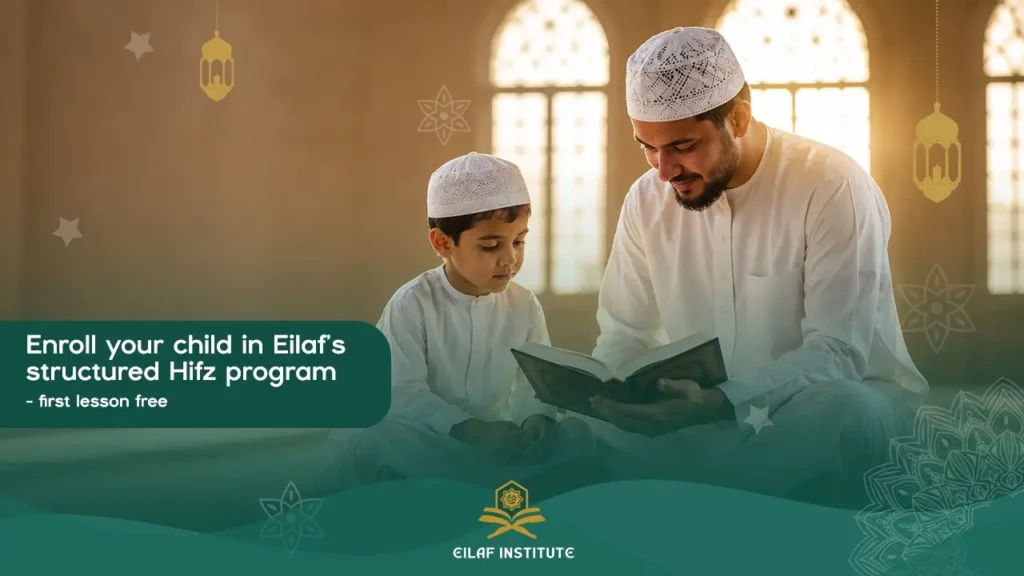
The Quran Hifz course for kids provides a comprehensive and structured framework for children to memorize the Holy Quran. By integrating systematic repetition with precise Tajweed rules, the program guides students through manageable milestones. Our approach emphasizes consistent revision and expert mentorship, ensuring that children develop a profound, lifelong bond with the Quran in a supportive environment.
Quran Hifz Course for Kids – How It Works?
A Quran Hifz course for kids works by transforming a massive goal, memorizing over 600 pages, into small, digestible daily tasks. The process begins with an evaluation of the child’s current reading level and Tajweed proficiency. Once the foundation is set, the teacher introduces a customized schedule that balances new memorization with the review of previously learned verses.
The Three-Pillar System
To make the process effective, most professional programs, including those at Eilaf Institute, follow a three-part daily routine:
- Sabaq (New Lesson): The new verses the child learns every day.
- Sabqi (Recent Revision): Reviewing the verses learned in the last 7 to 10 days to ensure they move from short-term to long-term memory.
- Manzil (Old Revision): Reviewing older portions of the Quran to prevent them from being forgotten.
Interactive 1-on-1 Sessions
Unlike large classroom settings, online hifz classes for kids focus on individual attention. Each child has a unique pace; some may memorize five lines a day, while others may start with just two. The teacher listens to the child’s recitation, corrects their mistakes in real-time, and uses repetition techniques to solidify the verses before the session ends.
What Makes a Hifz Course Different from Regular Quran Classes?
A Quran memorization course for children differs from standard reading classes because its primary objective is retention and mastery, rather than just decoding Arabic text. While a regular class might focus on finishing a chapter to understand its meaning or basic rules, a Hifz course is an intensive journey of mental discipline and spiritual connection.
Specialized Teaching Methods
In a standard class, once a child finishes a Surah, they move to the next. In a Hifz program, finishing a Surah is only the beginning. The teacher uses Best Quran Memorization Techniques, such as “The Look-and-Say Method” or “The Verse-Linkage Technique,” where the child connects the end of one verse to the start of the next.
Emphasis on Tajweed Classes for Kids
You cannot separate Hifz from Tajweed. If a child memorizes a verse with the wrong pronunciation, it is incredibly difficult to correct later. Therefore, a Hifz course integrates Tajweed Classes for Kids directly into the curriculum. This ensures that every word is stored in the brain with its correct phonetic attributes, making the recitation beautiful and accurate from the start.
Long-Term Commitment vs. Short-Term Goals
Think of a regular Quran class like a casual jog in the park, while a Hifz course is more like training for a marathon. The former focuses on daily activity, while the latter requires a strict regimen, nutritional discipline (spiritual and mental focus), and a long-term roadmap that spans several years.
The Typical Hifz Journey for a Child (Months 1–12)
The first year of a Quran memorization program is the most critical because it sets the “habit of Hifz.” It is during these twelve months that the child moves from struggling with focus to developing a “memorization muscle.”
Months 1–3: The Foundation and Short Surahs
During the first quarter, the focus is on Juz Amma (the 30th part). These Surahs are short and rhythmic, making them perfect for building confidence. The teacher assesses the child’s speed and introduces them to the daily routine of revision. This phase is like building the foundation of a house; if it isn’t solid, the rest of the structure will be unstable.
Months 4–8: Building Momentum
Once the child has memorized several short Surahs, their brain starts to adapt to the patterns of the Quran. During this middle phase, the length of the daily “Sabaq” usually increases. The child begins to tackle medium-sized Surahs. Teachers at Eilaf Institute often use this period to strengthen the child’s Tajweed Classes for Kids skills, ensuring that as the verses get longer, the quality of recitation remains high.
Months 9–12: Establishing the Revision Habit
By the end of the first year, the child often completes one or two Juz. The challenge now shifts from “how much can I learn” to “how much can I remember.” The “Manzil” (old revision) becomes a core part of the daily routine. The child learns that Hifz is a cycle of learning and returning, ensuring that what was learned in Month 1 is still fresh in Month 12.
Book now your place in the Quran memorization for kids course!
How Much Time Does a Child Need to Dedicate?
A child typically needs to dedicate between 45 and 90 minutes per day to a Kids’ Hifz Program Online, depending on their age and the intensity of the program. This time is usually split between the live session with the tutor and independent “home” revision.
Quality Over Quantity
It is a common misconception that a child must spend hours staring at a Mushaf. In reality, 30 minutes of high-focus memorization is far more effective than two hours of distracted reading. Consistency is the “secret sauce.” Memorizing for 20 minutes every single day is better than trying to memorize for three hours once a week.
Factoring in Age and Academic Load
- Ages 5–7: Usually require shorter sessions (20–30 minutes) with more frequent breaks to accommodate shorter attention spans.
- Ages 8–12: Can handle 45–60 minute sessions and are capable of managing a more rigorous revision schedule alongside their schoolwork.
The Role of Parental Support
While the teacher handles the instruction during online hifz classes for kids, parents play the role of “coaches.” They help set the environment, a quiet space, a fixed time, and positive encouragement. Think of the teacher as the professional trainer and the parent as the supportive team manager; both are essential for the child to reach the finish line.
How Eilaf Structures Its Kids’ Hifz Program
Eilaf Institute structures its Quran Hifz course for kids around the principle of “Personalized Excellence,” recognizing that no two children learn at the same speed. Our program is built on a framework that balances psychological motivation with traditional Islamic pedagogy.
Step 1: Matching the Right Tutor
We don’t just assign any teacher. We match the child with a tutor who fits their personality and learning style. For a shy child, we provide a gentle, encouraging mentor. For a more energetic child, we provide a teacher who uses interactive tools and high-engagement techniques.
Step 2: Utilizing the Best Quran Memorization Techniques
Our curriculum employs the “Circle Revision Method.” This ensures that the child is constantly circling back to older lessons. We also utilize auditory learning tools, where kids listen to famous Qaris to perfect their rhythm and Tajweed. This multi-sensory approach makes the Quran Hafiz course for children more engaging and helps the brain encode information through sight, sound, and speech.
Step 3: Regular Progress Reports and Incentives
We maintain a digital log of every verse memorized. Parents receive regular updates on their child’s progress, strengths, and areas needing improvement. To keep the motivation high, we use a system of rewards and certificates. Just as a child receives a trophy for sports, we believe celebrating the completion of a Juz is vital for their spiritual and emotional growth.
Can a child do Hifz online?
Yes, a child can complete Hifz online through a dedicated Kids’ Hifz Program Online. With modern screen-sharing tools and high-quality audio, a teacher can correct Tajweed and monitor memorization just as effectively as in a physical classroom. In many cases, the 1-on-1 nature of online classes provides fewer distractions than a traditional group setting.
How long does it take a child to complete Hifz?
The duration varies based on the child’s pace and daily commitment. On average, a child dedicating an hour a day can complete the full Quran in 3 to 5 years. However, some children choose to memorize specific Surahs or parts (Juz), which can be achieved in a much shorter timeframe. The goal is always “quality of retention” over “speed of completion.”
At what age is best for a child to start Hifz?
Most experts suggest that age 6 or 7 is an ideal time to start a Quran memorization course for children. At this age, a child’s brain is like a sponge, capable of absorbing and retaining information with incredible speed. However, they should already have a basic grasp of reading Arabic (the Qaida) to ensure they are memorizing words correctly.