
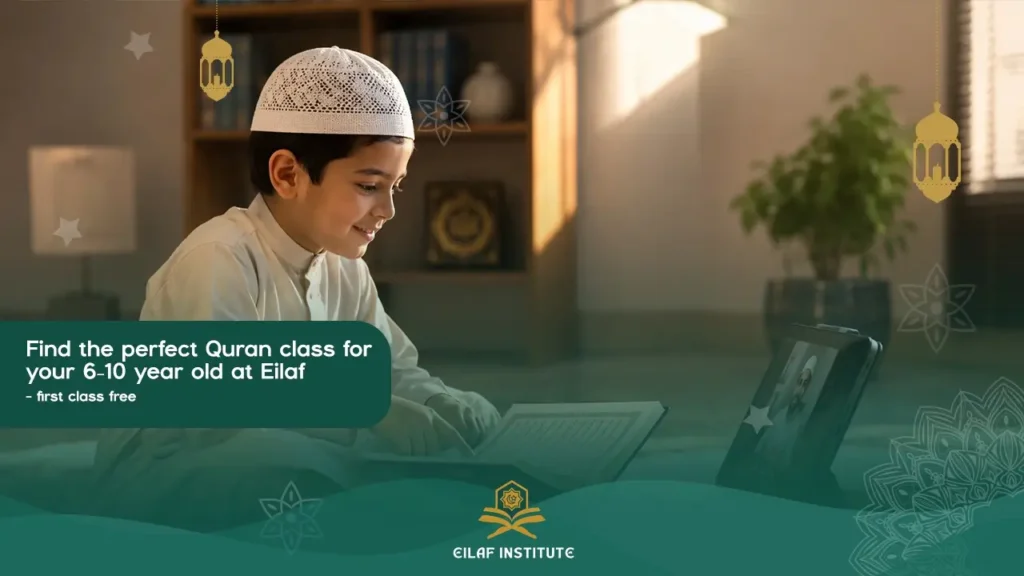
Online Quran classes for ages 6-10 capitalize on school-aged children’s enhanced learning capacity. The program moves beyond auditory learning to focus on structured memorization and fluent reading. Through an analytical curriculum, students master Tajweed rules and complex Arabic patterns, ensuring they build a sophisticated and independent relationship with the Holy Quran.
What Children Ages 6–10 Can Achieve in the Quran?
At these ages, children are capable of achieving complete reading fluency from the Mushaf, mastering the foundational rules of Tajweed, and memorizing several Juz (parts) of the Quran. This is often described as the “golden age” for learning because the brain is like a highly absorbent sponge, yet it has developed the discipline required for formal study.
Transition to Independent Reading
Unlike younger children who rely solely on repeating what they hear, a 7 or 8-year-old begins to decode the language. By the end of this period, many students can pick up any page of the Quran and recite it with proper vowels and stops without needing a teacher to lead every word.
Building Spiritual Identity
This age group starts to ask “why.” A well-structured Kids’ Quran course at a primary age doesn’t just teach recitation; it introduces the stories of the Prophets. This helps the child build a personal connection with the Book, seeing it as a guide rather than just a textbook.
Milestone Achievements
- Ages 6-7: Completing the Noorani Qaida and starting the last Juz (Juz Amma).
- Ages 8-9: Mastering heavy and light letters and beginning the transition to longer Surahs.
- Age 10: Establishing a consistent revision habit and potentially moving toward online Quran classes for teenagers, which focus more on deep meaning and advanced Hifz.
Reading, Memorization, or Tajweed – Where to Start?
The most effective starting point is reading fluency combined with basic Tajweed rules, as this prevents the child from memorizing mistakes that are difficult to correct later. While memorization is rewarding, it must be built on a foundation of correct pronunciation.
The “Map and Destination” Approach
Imagine trying to navigate a new city. Reading is like having a map, while memorization is reaching the destination. If a child tries to reach the destination without knowing how to read the map, they will get lost or rely entirely on others. By teaching the Quran to a 7-year-old through a reading-first approach, we give them the tools to explore the Quran independently for the rest of their lives.
Integrating Tajweed from Day One
Tajweed is not an “extra” skill; it is the correct way to read the Quran. Instead of teaching Tajweed as a separate, boring theory class, we integrate it into daily practice.
- Visual Cues: Using color-coded Qurans to identify rules.
- Physical Memory: Using hand gestures to explain the length of vowels (Mad).
- Corrective Feedback: Real-time adjustments by the tutor to ensure the tongue is placed correctly for difficult Arabic letters.
Read also about: online Quran classes for toddlers ages 3-5
5 Ways to Choose the Right Online Quran Classes for Ages 6-10
To choose the best program, parents should look for specialized instructors, interactive curriculum designs, a focus on individual pacing, progress tracking mechanisms, and a trial period to test student-teacher chemistry. Quran classes for primary school kids require a different energy level than adult classes, so the “vibe” of the session matters immensely.
1. Teacher-Student Chemistry
The teacher must be more than a scholar; they must be a mentor. For this age group, a teacher who uses encouragement and smiles will achieve ten times more than one who is overly strict.
2. Use of Gamification
Since children in this age bracket are often used to interactive school apps, the Quran class should feel modern. Look for programs that use:
- Digital whiteboards.
- Quranic games or quizzes.
- Reward systems (stars, points, or digital badges).
3. Structured Progress Reports
You shouldn’t have to wonder what your child learned this month. A professional institute provides monthly logs showing which verses were covered and which Tajweed rules were mastered.
4. Flexibility and Trial Classes
Every child is unique. A trial class allows you to see if the teacher’s pace matches your child’s learning speed. Some kids need more time on phonics, while others are ready to fly through memorization.
5. Safety and Supervision
Online safety is paramount. Ensure the platform used is secure and that the institute has a clear policy regarding teacher conduct and parental involvement.
Book now: Quran classes for kids
Balancing Quran Classes with School and Activities
Balancing Quran study with school is best achieved by making the Quran a small, daily habit rather than a large, weekly chore. Much like brushing teeth, the key isn’t how long you do it, but that you never skip a day.
The “Prime Time” Strategy
Find the time of day when your child is most alert but not stressed by schoolwork. For some, this is 20 minutes before breakfast; for others, it is immediately after coming home from school, before they start their homework.
Micro-Learning Habits
On days when the school load is heavy, don’t cancel the Quran session. Instead, ask the teacher for a “light” session focused on revision rather than new material.
- 15 minutes of revision is better than 0 minutes.
- Listening to the Quran in the car on the way to sports practice keeps the mind engaged.
- Consistency over Intensity: A child who studies for 20 minutes five times a week will progress faster than a child who studies for two hours once a week.
Creating a Dedicated Space
Just as a child has a desk for schoolwork, they should have a quiet, clean corner for their Quran class. This physical space helps the brain “switch” into a state of respect and focus, making the transition from secular school to religious study much smoother.
Should a 7-year-old focus on reading or memorization first?
A 7-year-old should prioritize reading fluency (Qaida) while doing “incidental” memorization of short Surahs. If they memorize without knowing how to read, they are just mimicking sounds. If they learn to read first, they can memorize any part of the Quran accurately for the rest of their lives.
How many Quran lessons per week for a primary school child?
For most children aged 6-10, 3 to 4 sessions per week are ideal. This frequency provides enough repetition to ensure they don’t forget the previous lesson, while still leaving plenty of time for school, homework, and physical play.
How do I fit Quran into a busy school-age schedule?
The best way is to keep the sessions short (30 minutes) and consistent. Treat the Quran class as a non-negotiable part of the routine, similar to school attendance. When the child sees that the Quran is a priority for the parents, they will naturally adopt the same mindset.