
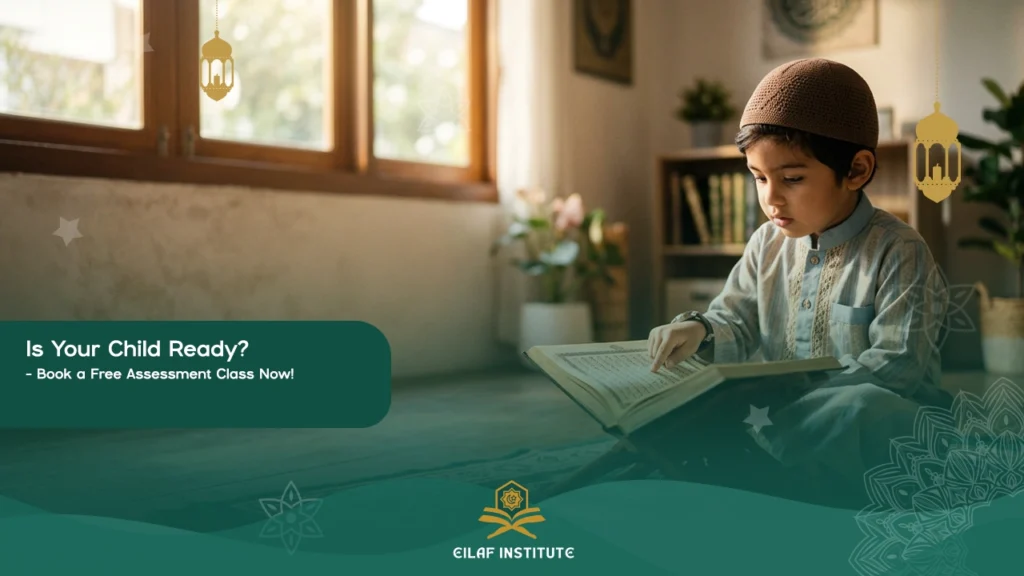
The best age to start Tajweed for kids typically falls between five and seven years old, a period when children possess the cognitive focus to follow instructions and the linguistic flexibility to mimic complex sounds. While early exposure through listening can begin even sooner, this specific window allows for a formal introduction to phonetic rules without overwhelming the child. By starting during these foundational years, parents ensure that their children develop a correct and beautiful recitation style that becomes a permanent part of their identity.
Signs Your Child Is Ready to Start Learning Tajweed
A child is ready to begin their Tajweed journey when they can articulate sounds clearly in their native language and show a basic curiosity about the rhythm of the Quran. Readiness is not just about age; it is about the developmental milestones that allow a child to process and repeat specific phonetic instructions.
To identify Signs of Tajweed Readiness in Children, parents should look for:
- Clear Speech Patterns: The child should be able to pronounce most letters in their primary language without significant speech impediments.
- Basic Alphabet Recognition: If the child can identify Arabic letters and distinguish between their different shapes, they are prepared for the next step.
- Mimicry Skills: A child who naturally tries to imitate the reciter during prayer or while listening to the Quran is showing an auditory readiness for Tajweed.
- Attention Span: The ability to sit and engage with a teacher for 15 to 20 minutes is essential for effective learning.
- Understanding of “Stop and Go”: Tajweed requires following the rules of when to pause and when to continue; if a child can follow simple multi-step instructions, they can handle basic Tajweed.
Best age to start Tajweed for kids: An Age-by-Age Guide
The journey of learning is a progressive one, moving from passive absorption to active application of rules. When to start Tajweed depends on the specific stage of the child’s development, as each age group requires a different pedagogical approach.
Ages 3–4 (The Exposure Stage):
This is the ideal time for Preschool Quran Learning. At this age, children should not be pushed to learn formal rules. Instead, they should listen to high-quality recitations frequently. Their brains are like sponges, and they will naturally pick up the “rhythm” of Tajweed through passive listening.
Ages 5–6 (The Foundation Stage):
This is often considered The Right Age to learn the Quran Tajweed foundations. Children can start learning the points of articulation (Makharij) and the basic vowels. They can understand simple concepts like stretching a sound or making a nasal sound without needing to know the technical names of the rules.
Ages 7–9 (The Formal Rules Stage):
By this age, children can begin to study the technicalities, such as the rules of Noon Sakinah and Tanween. Their logical reasoning is more developed, allowing them to understand the “why” behind the rules and apply them consistently across different Surahs.
Read also about: Why Should Kids Learn Tajweed from the Beginning?
How to Introduce Tajweed in a Gentle and Engaging Way
Introducing Tajweed should be a positive and stress-free experience that focuses on the beauty of the Quran rather than just the rigidity of the rules. For parents, the goal is to foster a love for the Quran while maintaining a high standard of recitation.
- Use Audio-Visual Tools: Play recitations by child reciters so your child can hear a voice that sounds like theirs. Use color-coded Qurans where different colors signify different rules, making it a visual game of “finding the colors.”
- Short and Frequent Sessions: It is better to practice for 10 minutes every day than to have one long, exhausting hour once a week. This keeps the information fresh and prevents the child from feeling burnt out.
- The “Repeat After Me” Method: Use the traditional method of “Talaqqi,” where the teacher recites a small portion, and the child repeats it. This mimics how the Quran was originally transmitted and is the most effective way for kids to learn.
- Celebrate Small Wins: When a child correctly applies a difficult rule like “Qalqalah” (the bouncing sound), offer immediate verbal praise or a small reward. This builds their confidence and makes them eager for the next lesson.
How Eilaf101 Tailors Tajweed Programs for Every Age Group
At Eilaf101, we understand that children at different ages learn in unique ways. A six-year-old, for example, processes information very differently from a ten-year-old, which is why our Tajweed curriculum is carefully designed around age-specific learning stages.
What about Eilaf Academy programs?
Our programs are divided into structured, age-appropriate modules that align with each child’s cognitive development, attention span, and learning pace. Every instructor is specially trained to adapt their teaching methods, communication style, and lesson delivery to meet the individual needs of each student, ensuring that every child feels both supported and appropriately challenged throughout their learning journey.
To create an engaging and enjoyable learning experience, we incorporate interactive whiteboards, dynamic digital presentations, and continuous feedback mechanisms that help children stay motivated and actively participate in every lesson.
Join us now
Parents who are looking for professional, age-appropriate Quran instruction are encouraged to enroll their children in our Quran Tajweed Course for Kids and begin a rewarding journey toward accurate, confident, and beautiful Quran recitation.
Can a 3-Year-Old Start Learning Tajweed?
While a 3-year-old is too young for formal rules, they can start “informal” Tajweed through Preschool Quran Learning. This involves listening to correct recitation and mimicking short verses. The focus at this age should be on love and familiarity rather than technical accuracy.
Is It Ever Too Late for a Child to Start Learning Tajweed?
It is never too late. While the “golden age” is early childhood due to vocal flexibility, older children and even teenagers can master Tajweed with the right teacher. The main difference is that an older child will rely more on logical understanding and conscious practice than on natural mimicry.
How do I know if my child is ready?
Look for the Signs of Tajweed Readiness in Children, such as their ability to repeat sounds accurately, their interest in the Quran, and their ability to stay focused for at least 15 minutes. If they can recognize the Arabic letters and speak clearly in their daily life, they are likely ready to start.