
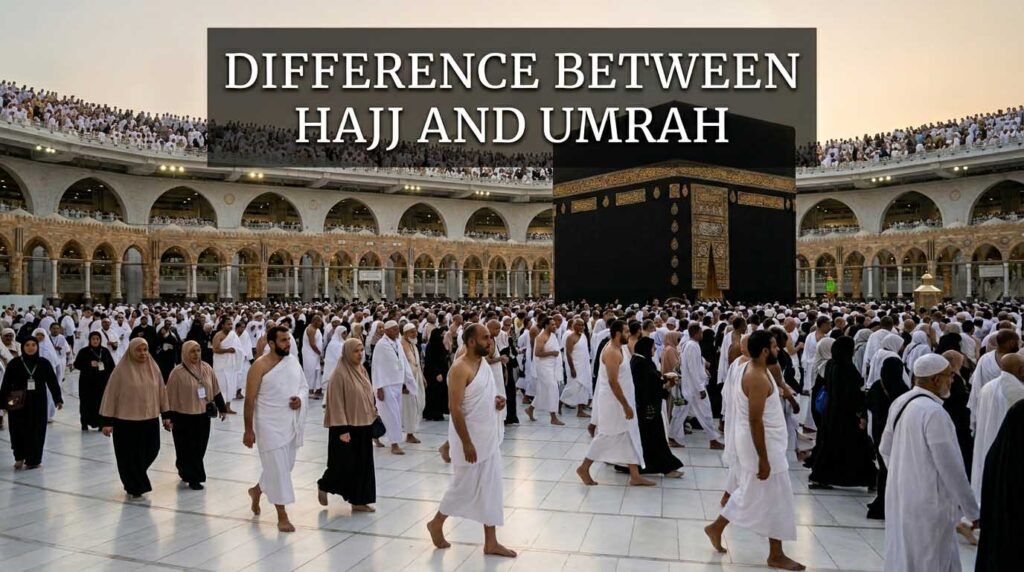
The main difference between Hajj and Umrah in the Quran is that Hajj is an obligatory pilgrimage performed during specific days of Dhul-Hijjah, while Umrah is a shorter pilgrimage that may generally be performed throughout the year. Both include ihram, tawaf, and sa’i, but only Hajj includes standing at Arafat, Mina, Muzdalifah, and the Jamarat.
What Is Hajj?
Hajj is the major pilgrimage to the Sacred House of Allah in Makkah and one of the Five Pillars of Islam. It is obligatory once in a lifetime for every adult Muslim who has the physical, financial, and practical ability to undertake the journey safely.
Allah states in Surah Ali ‘Imran:
“Pilgrimage to this House is an obligation by Allah upon whoever is able among the people.” (Quran 3:97)
Hajj takes place during Dhul-Hijjah, the final month of the Islamic calendar. Its main rites are performed from the 8th through the 13th of Dhul-Hijjah and involve travelling between Makkah, Mina, Arafat, and Muzdalifah.
These rites commemorate obedience to Allah and are closely connected to the legacy of Prophet Ibrahim, Hajar, and Isma’il, peace be upon them.
What Is Umrah?
Umrah, commonly called the minor pilgrimage, is an act of worship performed by entering ihram, completing tawaf around the Kaaba, walking between Safa and Marwah, and shaving or trimming the hair. It is shorter than Hajj and does not include standing at Arafat or visiting Mina and Muzdalifah.
The Quran mentions Umrah together with Hajj:
“Complete the pilgrimage and minor pilgrimage for Allah.” (Quran 2:196)
Umrah may generally be performed throughout the year. However, international pilgrims must follow current Saudi visa, permit, health, and scheduling requirements, particularly during the period surrounding Hajj.
Hajj vs Umrah: What Are the Main Differences?
Hajj and Umrah differ in their religious ruling, timing, duration, required locations, and number of rites. The following comparison summarises the most important differences between Hajj and Umrah.
Is Hajj Obligatory and Is Umrah Compulsory?
Hajj is unquestionably obligatory once in a lifetime for every adult Muslim who is able to perform it. Scholars agree on this ruling. The status of Umrah is a recognised matter of scholarly disagreement: some schools consider it obligatory, while others classify it as a highly recommended Sunnah.
When Does Hajj Become Obligatory?
Hajj becomes obligatory when a Muslim meets the recognised conditions of ability. These generally include:
- Being Muslim and having reached adulthood
- Being mentally capable of religious responsibility
- Having sufficient physical ability to travel and perform the rites
- Having the necessary funds after essential personal and family expenses
- Having a reasonably safe and legally available route to pilgrimage
Illness, disability, debt, caregiving responsibilities, and other personal circumstances may affect how these conditions apply. A qualified scholar should be consulted when a person’s situation involves additional considerations.
Can Umrah Replace the Obligation of Hajj?
No. Umrah cannot replace obligatory Hajj, even when it is performed repeatedly or during Ramadan. An able Muslim who has completed Umrah must still perform Hajj once in a lifetime because Hajj and Umrah are distinct acts of worship with different requirements, times, and rites.
When Are Hajj and Umrah Performed?
Hajj can only be performed during its prescribed season, while Umrah may generally be completed throughout the year. This difference in timing is one of the main reasons Umrah offers greater flexibility for Muslims travelling from the USA, UK, and other countries.
When Is Hajj Performed?
The Quran states, “Hajj is during well-known months” (Quran 2:197). The principal days and rites are:
- 8th of Dhul-Hijjah: Pilgrims proceed to Mina for the Day of Tarwiyah.
- 9th of Dhul-Hijjah: Pilgrims stand at Arafat and later travel to Muzdalifah.
- 10th of Dhul-Hijjah: Pilgrims stone Jamrat al-Aqabah, offer the required sacrifice, cut their hair, and perform Tawaf al-Ifadah.
- 11th and 12th of Dhul-Hijjah: Pilgrims stone the three Jamarat at Mina.
- 13th of Dhul-Hijjah: Pilgrims who remain in Mina complete an additional day of stoning.
Can Umrah Be Performed at Any Time?
Religiously, Umrah may be performed throughout the year. In practice, access can be restricted around the Hajj season to accommodate authorised Hajj pilgrims and manage the sacred sites. Travellers should check the latest official Saudi visa, permit, booking, and health requirements before making arrangements.
What Are the Main Rites of Umrah?
The main rites of Umrah are entering ihram, performing tawaf, completing sa’i, and shaving or trimming the hair. These rites must be completed in their prescribed sequence. Umrah does not include Arafat, Mina, Muzdalifah, or the stoning of the Jamarat.
- Enter ihram: Make the intention for Umrah at or before the applicable miqat and begin reciting the Talbiyah.
- Perform tawaf: Circle the Kaaba seven times, beginning and ending in line with the Black Stone.
- Perform sa’i: Complete seven passages between Safa and Marwah, beginning at Safa and ending at Marwah.
- Shave or trim the hair: Men shave or shorten their hair, while women trim a small amount from their hair. This completes Umrah and ends the state of ihram.
Although the core rites may be completed within several hours, the actual duration depends on crowd levels, walking ability, rest requirements, and the time needed to move through the Sacred Mosque.
What Are the Main Rites of Hajj?
Hajj includes ihram, Mina, standing at Arafat, Muzdalifah, stoning the Jamarat, shaving or trimming the hair, and Tawaf al-Ifadah. Depending on the type of Hajj, the pilgrim may also perform an earlier tawaf and sa’i and may be required to offer a sacrifice.
- Enter ihram: Form the intention for the selected type of Hajj.
- Proceed to Mina: Travel to Mina on the 8th of Dhul-Hijjah.
- Stand at Arafat: Remain within the boundaries of Arafat during the prescribed time on the 9th of Dhul-Hijjah.
- Travel to Muzdalifah: Leave Arafat after sunset and spend the prescribed period at Muzdalifah.
- Stone Jamrat al-Aqabah: Cast seven pebbles on the 10th of Dhul-Hijjah.
- Offer the sacrifice when required: This applies particularly to Hajj al-Tamattu’ and Hajj al-Qiran.
- Shave or trim the hair: Complete the relevant stage of leaving the restrictions of ihram.
- Perform Tawaf al-Ifadah: Return to the Sacred Mosque and circle the Kaaba seven times.
- Stone the three Jamarat: Complete the prescribed stoning during the following days in Mina.
- Perform Tawaf al-Wada’: Complete the farewell tawaf before leaving Makkah when it is required.
The detailed order can vary according to whether the pilgrim performs Hajj al-Ifrad, Hajj al-Qiran, or Hajj al-Tamattu’. Pilgrims should learn the rulings for their chosen form before travelling.
What Are the Three Types of Hajj?
The three types of Hajj are Hajj al-Ifrad, Hajj al-Qiran, and Hajj al-Tamattu’. They differ in how Hajj is combined with Umrah, when the pilgrim leaves ihram, and whether a sacrificial offering is required.
Hajj al-Ifrad
In Hajj al-Ifrad, the pilgrim enters ihram for Hajj alone. Umrah is not combined with Hajj under the same intention, and a sacrifice is not required solely because the pilgrim selected this form.
Hajj al-Qiran
In Hajj al-Qiran, the pilgrim combines Hajj and Umrah under one ihram and remains in that state until the appropriate stage of Hajj. An able pilgrim performing this form must provide the prescribed sacrificial offering.
Hajj al-Tamattu’
In Hajj al-Tamattu’, the pilgrim performs Umrah during the Hajj months, leaves ihram after completing it, and later enters ihram again for Hajj. An able pilgrim performing Hajj al-Tamattu’ must provide the prescribed sacrifice.
Why Is Standing at Arafat the Clearest Difference?
Standing within the boundaries of Arafat during its prescribed time is an essential pillar of Hajj. A pilgrim who misses it has not completed a valid Hajj. Umrah has no standing at Arafat, making this one of the clearest differences between Hajj and Umrah.
The Day of Arafah falls on the 9th of Dhul-Hijjah. Pilgrims devote this time to prayer, remembrance, repentance, and supplication before leaving for Muzdalifah after sunset.
Is a Sacrifice Required for Hajj or Umrah?
A sacrificial offering is not required merely because a person performs Umrah. During Hajj, it is normally required from pilgrims performing Hajj al-Tamattu’ or Hajj al-Qiran when they are able. It is not automatically required from someone performing Hajj al-Ifrad.
A separate sacrifice or compensation may become necessary if a pilgrim violates particular ihram restrictions or fails to complete certain obligatory duties. These situations have detailed rulings and should be discussed with a knowledgeable scholar.
What Are the Similarities Between Hajj and Umrah?
Hajj and Umrah are both pilgrimages performed for Allah at the Sacred Mosque in Makkah. Both require sincere intention, entry into ihram, tawaf around the Kaaba, sa’i between Safa and Marwah, and completion according to prescribed Islamic guidance.
- Both are acts of worship performed for Allah alone.
- Both require entering the sacred state of ihram.
- Both include seven circuits of tawaf around the Kaaba.
- Both include seven passages of sa’i between Safa and Marwah.
- Both involve shaving or trimming the hair at the appropriate stage.
- Both require pilgrims to follow the restrictions of ihram.
- Both teach sincerity, humility, patience, discipline, and obedience.
- Both are connected to the legacy of Prophet Ibrahim, Hajar, and Isma’il, peace be upon them.
How Does the Quran Describe Hajj and Umrah?
The Quran establishes the obligation of Hajj for those who are able and commands believers to complete both Hajj and Umrah for Allah. It also provides guidance about pilgrimage timing, conduct, remembrance, sacrifice, Arafat, and completing the prescribed rites.
Surah Ali ‘Imran 3:97
This verse establishes pilgrimage to the Sacred House as an obligation for those who are able to undertake the journey. It is the clearest Quranic evidence for the compulsory status of Hajj.
Surah Al-Baqarah 2:196
This verse commands Muslims to complete Hajj and Umrah for Allah. It also discusses being prevented from completing the pilgrimage, sacrificial offerings, compensation, and combining Umrah with Hajj.
Surah Al-Baqarah 2:197
This verse explains that Hajj takes place during recognised months. It also teaches pilgrims to avoid improper conduct, sin, and argument during Hajj.
Surah Al-Baqarah 2:198–203
These verses discuss Arafat, Mash’ar al-Haram, remembrance of Allah, and the numbered days of pilgrimage. They connect the physical rites of Hajj with gratitude, worship, and consciousness of Allah.
Surah Al-Hajj 22:27–29
These verses describe the call to pilgrimage and instruct pilgrims to complete their prescribed duties, fulfil their vows, and perform tawaf around the Ancient House.
The Quran discusses Hajj in greater procedural detail because it is an obligatory pillar with time-specific rites. However, Quran 2:196 mentions Hajj and Umrah separately, demonstrating that Umrah is not simply another name for Hajj.
What Are the Spiritual Benefits of Hajj and Umrah?
Hajj and Umrah cultivate repentance, humility, patience, remembrance of Allah, and unity among Muslims. Their spiritual value is not produced by travel alone; it depends on sincere intention, correct worship, lawful conduct, and avoiding behaviour that contradicts the purpose of pilgrimage.
Submission to Allah
Pilgrims follow a divinely prescribed sequence of worship rather than personal preference. This teaches obedience, discipline, and willingness to place Allah’s commands before individual desires.
Humility and Equality
Ihram reduces visible distinctions of wealth, nationality, profession, and social status. Pilgrims gather in simple clothing and perform the same rites, reinforcing their equality before Allah.
Unity Among Muslims
Muslims from different cultures and countries gather at the same sacred sites, face the same direction in prayer, and complete the same acts of worship. This demonstrates the international unity of the Muslim community.
Patience and Self-Control
Travel, crowds, walking, heat, and waiting can be physically and emotionally demanding. Pilgrimage teaches patience, restraint, kindness, and consideration for other worshippers.
Repentance and Spiritual Renewal
Hajj and Umrah give Muslims an opportunity to seek forgiveness, review their conduct, and renew their commitment to Allah. The lasting benefit of pilgrimage should appear in stronger faith and improved behaviour after returning home.
The Prophet Muhammad, peace and blessings be upon him, taught that one Umrah to the next is an expiation for what occurs between them and that an accepted Hajj has Paradise as its reward. These teachings describe the virtue of sincere and accepted worship; they should not be treated as permission to persist deliberately in wrongdoing.
Conclusion
The difference between Hajj and Umrah in the Quran is primarily found in their obligation, timing, duration, and required rites. Hajj is an obligatory, time-specific pillar that includes Arafat, Mina, Muzdalifah, and the Jamarat. Umrah is shorter, has fewer rites, and may generally be performed throughout the year.
Both pilgrimages require sincere devotion and teach humility, patience, repentance, and obedience to Allah. Eilaf Academy encourages Muslims to deepen their understanding of Hajj and Umrah through the Quran, authentic Sunnah, and reliable scholarly guidance before beginning either sacred journey.
Frequently Asked Questions
Can I Perform Umrah Before Hajj?
Yes. A Muslim may perform Umrah before completing Hajj. However, Umrah does not replace obligatory Hajj. If a person meets the conditions that make Hajj compulsory, it should not be postponed without a valid reason simply because that person has already performed Umrah.
How Long Does Umrah Take Compared With Hajj?
The core rites of Umrah can often be completed within several hours, although crowd levels, mobility, and rest periods may extend the time. Hajj takes several days because pilgrims travel between Makkah, Mina, Arafat, and Muzdalifah and perform rites assigned to specific dates.
Are the Pillars of Hajj and Umrah the Same?
No. Hajj and Umrah share ihram, tawaf, and sa’i, but their pillars are not identical. Standing at Arafat is an essential pillar of Hajj and is not part of Umrah. The classification of certain pillars and obligatory acts may differ slightly among Islamic schools of law.
Does Umrah Include Visiting Madinah?
No. Visiting Madinah and the Prophet’s Mosque is a blessed but separate journey. It is not a pillar, condition, or required rite of Umrah. Umrah is performed in Makkah through ihram, tawaf, sa’i, and shaving or trimming the hair.
Is Umrah During Ramadan Equal to Hajj?
An authentic hadith states that Umrah during Ramadan carries a reward comparable to Hajj. This refers to spiritual reward and does not transform Umrah into Hajj or remove the obligation of Hajj. An able Muslim must still perform Hajj during its prescribed season.
Trusted Sources
- The Quran — Surah Ali ‘Imran 3:97
- The Quran — Surah Al-Baqarah 2:196
- The Quran — Surah Al-Baqarah 2:197
- Sahih Muslim 1349a — Reward of Hajj and Umrah
- Nusuk — Official Hajj Rituals Guide
- Nusuk — Official Umrah Journey and Rites
- Saudi Ministry of Hajj and Umrah