
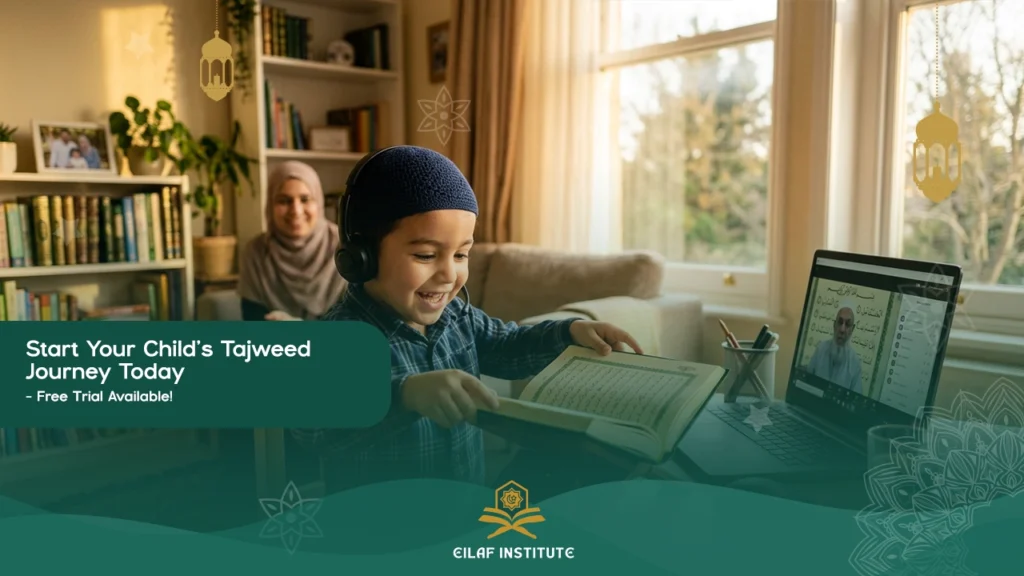
Parents often prioritize the memorization of verses when they begin their child’s religious education, but the method of delivery is equally significant. A child’s initial relationship with the Quran is shaped by how they are taught to pronounce its letters and words. This reality often leads families to ask: Why should kids learn Tajweed from the beginning rather than waiting until they are older and more linguistically mature? By starting with the correct phonetic rules, children avoid the common trap of learning the wrong way and having to unlearn those mistakes years later, which is a much more difficult and frustrating task.
Why Should Kids Learn Tajweed from the Beginning?
Learning Tajweed from the start ensures that the child respects the linguistic integrity of the Quran and builds a foundation of accuracy that will last a lifetime. When a child is taught the rules of recitation alongside the letters, they treat the Quran as a unique and sacred form of speech, distinct from their everyday language.
1- Prevention of Inaccurate Habits:
Once a child becomes accustomed to mispronouncing a letter, such as substituting a “Seen” for a “Saad,” that habit becomes deeply ingrained in their muscle memory. Correcting this in adulthood requires significant effort.
2- Preservation of Meaning:
The Arabic language is extremely precise. A slight change in the articulation of a letter can change a word from a blessing to a warning. Tajweed’s importance for children lies in protecting them from making these unintended mistakes.
3- Building Early Fluency:
A child who learns the rules of stretching (Madd) and nasal sounds (Ghunnah) early will find that their recitation flows naturally. They won’t have to “think” about the rules as they get older because the rules will have become second nature to them.
4- Aesthetic Appreciation:
Tajweed is what gives the Quran its beautiful, melodic quality. When children can recite beautifully, they are more likely to enjoy their practice and feel a sense of pride in their accomplishment.
How Young Children Naturally Learn Correct Pronunciation?
Children possess a remarkable biological advantage when it comes to picking up new sounds because their vocal cords and tongues are still highly flexible and developing. This phase of early tajweed learning is highly effective because children learn through mimicry rather than through complex theoretical explanations.
Heightened Auditory Perception:
Younger children can distinguish between subtle nuances in sound that adults often miss. They can hear the difference between the various “H” sounds in Arabic and replicate them with ease if they have a good role model.
The “Sponge” Effect:
The brain’s plasticity before the age of ten allows for the rapid acquisition of phonetic rules. Children don’t over-analyze the rules; they simply absorb the “rhythm” and “echo” of the teacher’s recitation.
Flexible Articulation Points:
The physical points of articulation (Makharij) in the throat and mouth are more adaptable in childhood. Teaching a child to produce a deep “Qaaf” from the back of the throat is much easier than teaching a forty-year-old whose throat muscles have been conditioned only for English sounds.
Lack of Inhibition:
Children are less afraid of making “funny” sounds or making mistakes. This lack of self-consciousness allows them to practice the heavy and vibrating sounds of Tajweed more freely than adults.
The Long-Term Benefits of Teaching Tajweed to Children
Beyond the immediate goal of reciting correctly, correct quran recitation in childhood provides cognitive and spiritual benefits that help the child in many other areas of life. These benefits contribute to a well-rounded personality and a strong Islamic identity.
- Increased Spiritual Focus (Khushu): When a child knows how to recite properly, they can focus on the beauty of the words rather than struggling with how to say them. This fosters a deeper emotional connection with Allah.
- Enhanced Memory Skills: Learning Tajweed requires a child to remember and apply multiple Tajweed rules simultaneously, including rules related to length, nasalization, and articulation. This mental exercise strengthens memory and concentration, benefiting not only Quranic studies but also their secular education.
- Public Speaking and Clarity: The discipline of Tajweed involves breath control and clear articulation. Many children who master Tajweed grow up to be confident public speakers because they have been trained to speak clearly and with a controlled pace.
- Cultural and Religious Pride: A child who excels in Tajweed is often encouraged by their community. This positive reinforcement builds a strong sense of belonging and pride in their Muslim heritage.
A Parent’s Guide: What to Expect When Your Child Learns Tajweed
The journey of learning Tajweed is a gradual progression, and as a parent, you should expect different milestones at different stages of your child’s development. Consistency from your side is what allows the teacher’s lessons to truly take root.
- The Phonetic Foundation: In the beginning, your child might spend weeks just practicing the alphabet. This is not “slow progress”; it is the most important part of the journey. They are training their mouth to produce sounds that do not exist in their native language.
- The Introduction of Symbols: Children will start to recognize the small marks (Harakaat) above and below letters. At this stage, they are learning the “tempo” of the language.
- Applying the Core Rules: You will start to hear your child “stretching” certain words or making a humming sound through their nose. This is when the rules of Madd and Ghunnah are being applied.
- Recitation and Correction: The final stage involves the child reading longer passages while the teacher provides real-time corrections. At this point, the parents’ role is to listen and encourage, even if the child is moving slowly through the pages.
Read also about: How to Learn Quran with Tajweed At Home
How Eilaf101’s Early Tajweed Program Supports Young Learners
Eilaf101 understands that children require a different pedagogical approach than adults, which is why our program is built around engagement, patience, and visual learning. We aim to make the science of Tajweed feel like a natural extension of the child’s voice.
- Tailored Curriculum: Our lessons are structured to introduce rules in a way that doesn’t overwhelm a young mind. We use metaphors, such as “the bouncing ball” for Qalqalah, to make the rules stick.
- Specialized Tutors: Our teachers are experts in child psychology and Tajweed, ensuring they can keep a child’s attention through a digital screen.
- Interactive Digital Environment: We use whiteboards and colored digital Qurans to help children visually track the rules as they recite.
- Getting Started: To give your child the best start in their religious education, you can enroll in the Quran Tajweed Course for Kids and watch them develop a beautiful, accurate recitation from the comfort of your home.
Is it harder to learn Tajweed later in life?
Yes, it is generally more challenging for adults because their speech patterns and muscle movements are already fixed. Adults often have to “unlearn” habits, whereas children start with a clean slate. However, with dedication, adults can still achieve mastery; it simply requires more time and conscious effort than it does for a child.
What Is the Best Age for Your Child to Start Learning Tajweed?
The ideal age is usually between 5 and 7 years old. At this age, children have a strong grasp of their primary language but are still in the peak window for phonetic acquisition. Starting any earlier might be difficult for their attention span, while starting much later means missing out on the period of maximum vocal flexibility.
Do kids need a teacher for tajweed?
Yes, Tajweed is an oral science that cannot be learned solely from books or videos. A teacher is necessary to listen to the child’s specific sounds and provide immediate corrections on the points of articulation. Without a teacher, a child might think they are pronouncing a letter correctly when they are actually slightly off.