
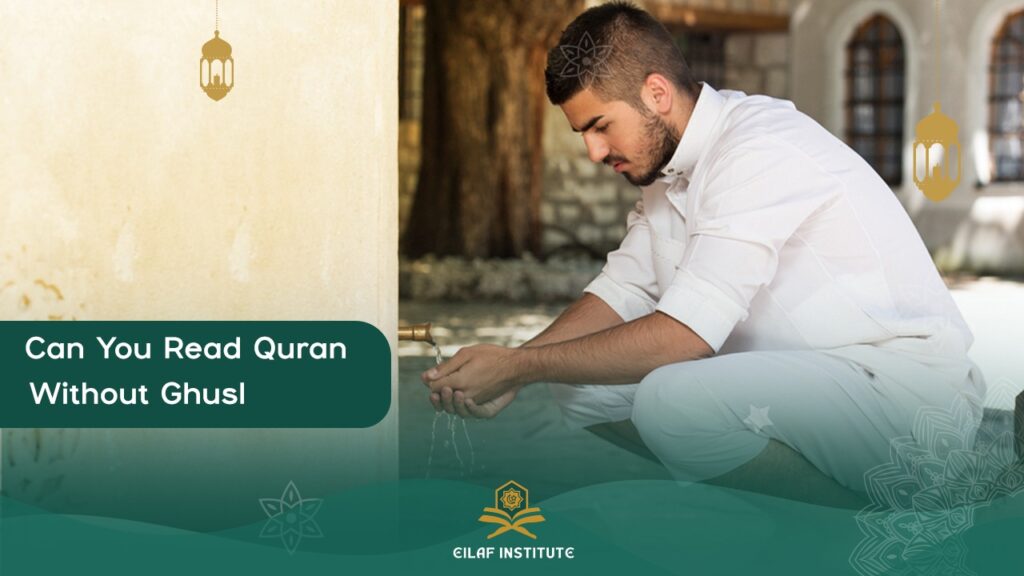
Can you read Quran without ghusl? If ghusl is required because of janabah, the majority of Sunni jurists say you should not verbally recite the Quran until you perform ghusl. You may, however, look at verses without pronouncing them, listen to Quran recitation, make dhikr, and hold a phone that contains a Quran app. At Eilaf Institute, students are taught these rulings according to authentic Islamic sources, helping them distinguish between different states of purification and the acts of worship permitted in each.
The ruling depends on what “without ghusl” means, because janabah, menstruation, postpartum bleeding, and simply not having wudu are not treated identically. It also matters whether you are reciting aloud, reading silently, listening, or touching a printed Mushaf.
What Does Being Without Ghusl Mean?
Ghusl is the full ritual washing required to leave a state of major ritual impurity. Janabah occurs after sexual intercourse or the discharge of sexual fluid, including through a wet dream. The Quran instructs Muslims in a state of janabah to purify themselves before performing prayer.
Ghusl is also required after menstruation or postpartum bleeding ends. However, menstruation is not simply another name for janabah. The two conditions have different causes, and Islamic jurists have expressed different rulings concerning Quran recitation during menstruation.
Not having wudu is a state of minor ritual impurity. It is different from janabah and does not normally prevent a person from reciting the Quran from memory or a digital device.
Start to learn read Quran with a certified online tutors
Can You Recite Quran Without Ghusl While in Janabah?
The majority position across the four Sunni schools is that a person in janabah should not verbally recite Quranic verses until performing ghusl. This applies whether the verses are recited from memory, read from a phone, or viewed in a printed copy, because the restriction concerns the act of recitation rather than its source.
This position is supported by reports from Ali ibn Abi Talib stating that nothing prevented the Prophet Muhammad, peace and blessings be upon him, from reciting the Quran except janabah. Some scholars have discussed the strength and interpretation of these reports, so the issue should be presented as the established majority ruling rather than an undisputed position held by every scholar.
While waiting to perform ghusl, a person may still:
- Look at Quranic verses without moving the lips or pronouncing them.
- Listen attentively to a recorded or live recitation.
- Read a translation or explanation that is not itself Quranic recitation.
- Make ordinary dhikr, tasbeeh, dua, and istighfar.
- Say Quranic phrases when they are intended as ordinary dua or remembrance, according to recognised juristic allowances.
Join a FREE TRAIL learn Quran online session
Can You Read Quran Without Ghusl on a Phone?
You may hold and operate a phone without ghusl because a phone is not treated as a printed Mushaf. However, if you are in janabah, the majority ruling still prevents you from verbally reciting the displayed verses. You may look at them silently or listen to the Quran until you have performed ghusl.
A phone remains a multipurpose device, and its Quranic text appears temporarily on a screen rather than existing as permanent writing throughout the device. Contemporary scholars therefore generally distinguish touching the phone from touching a physical copy of the Quran.
This distinction produces two separate rulings:
- Touching the device: Permissible, even when ghusl or wudu is required.
- Pronouncing Quranic verses: A person in janabah should wait until after ghusl according to the majority position.
Changing the format does not change the ruling on recitation. Reading aloud from a phone, tablet, computer, printed page, or memory is still verbal recitation.
Can You Read the Quran Silently in Janabah?
A person in janabah may look at Quranic text and reflect on it without pronouncing the words or deliberately moving the lips in recitation. Mental reading is distinguished from spoken recitation because no Quranic words are being articulated. This applies to verses displayed on a screen or presented without directly handling a Mushaf.
Someone waiting to perform ghusl may also study the meaning of a verse through an English translation or tafsir. A translation communicates the meaning of the Quran but is not itself the Arabic Quran. Care should still be taken when a book contains extensive Arabic Quranic text, especially if handling it directly.
Can You Touch a Physical Quran Without Ghusl?
The majority of jurists require ritual purity before directly touching a physical Mushaf. A person who needs ghusl should therefore avoid touching or carrying it until purification. This is stricter than the ruling for a phone, translation, or ordinary Islamic book that includes only limited Quranic quotations.
Jurists commonly cite the instruction that only the purified should touch the Quran, although scholars have discussed the precise interpretation of the relevant Quranic verse and supporting reports. The practical majority ruling remains that direct contact with a Mushaf requires purity.
Can You Listen to Quran Without Ghusl?
Yes, you may listen to the Quran without ghusl, including while in janabah. Listening is not the same act as verbally reciting, so the restriction applied by the majority to recitation does not prevent someone from hearing a recording, attending a lesson, or reflecting on verses being read by another person.
You may listen for worship, comfort, memorisation, or study. If you are following the text on a phone, you may look at the displayed verses. A person in janabah should avoid repeating the recitation aloud until ghusl has been completed.
Can You Read Quran Without Wudu?
You can recite the Quran from memory or read it from a phone without wudu, provided you are not in janabah or another condition requiring ghusl. The majority of jurists nevertheless require wudu for directly touching a printed Mushaf. Performing wudu before recitation remains recommended as an expression of respect.
Therefore, breaking wudu does not automatically mean that you must stop reciting. You may continue from memory or a digital screen. If you want to handle a physical Mushaf directly, renew your wudu first according to the majority ruling.
Can a Menstruating Woman Read the Quran?
Scholars differ over Quran recitation during menstruation. The majority of classical jurists generally prohibit verbal recitation until menstruation ends and ghusl is performed. Maliki jurists permit recitation during menstruation, including where learning, teaching, or preventing memorised passages from being forgotten is important.
This disagreement exists partly because menstruation may continue for several days and cannot be ended immediately through ghusl, unlike janabah. Some contemporary scholars therefore permit a menstruating woman to recite from memory or a phone, especially for study, teaching, regular remembrance, or fear of forgetting.
Under the majority position, she may still:
- Listen to Quran recitation.
- Look at verses without pronouncing them.
- Read translations and tafsir.
- Make dhikr, tasbeeh, and dua.
A woman following a particular school of Islamic law should apply its guidance or ask a qualified scholar who understands her circumstances. She should not be told that a recognised juristic position is invalid merely because another school reaches a different conclusion.
What Should You Do If Ghusl Cannot Be Performed?
If water is unavailable or its use would cause genuine harm because of illness or another recognised reason, Islamic law provides tayammum as a substitute for purification. The Quran mentions this concession in connection with illness, travel, lack of water, and states requiring purification.
The conditions and method of tayammum can differ in detail between legal schools. If your difficulty is ongoing, medical, or uncertain, consult a reliable local scholar rather than indefinitely postponing required worship or assuming that no alternative exists.
Conclusion
The majority answer to can you read Quran without ghusl is that verbal recitation should wait when you are in janabah. You may still hold a phone, look at verses silently, listen to the Quran, study translations, and make dhikr. Without wudu alone, recitation from memory or a digital device is permissible, while touching a Mushaf generally requires wudu.
Because menstruation involves recognised scholarly disagreement, women may follow a reliable ruling within an established school or seek personal guidance from a qualified scholar. Eilaf Institute’s Quran and Islamic studies programmes can also help learners understand Quran recitation alongside the relevant principles of worship and purification.
Frequently Asked Questions
Can I read Quran on my phone before performing ghusl?
You may touch the phone, open a Quran app, and look at the verses silently. If you are in janabah, the majority of jurists say you should not pronounce or verbally recite the verses until performing ghusl. If you merely lack wudu and are not in janabah, you may recite from the phone.
Can I listen to Quran while I am in janabah?
Yes. Listening to Quran recitation while in janabah is permissible because listening is distinct from reciting. You may listen to a recording, lesson, or live recitation and reflect on its meaning. Under the majority ruling, avoid repeating the Quranic words aloud until you have completed ghusl.
Can I do tasbeeh without ghusl?
Yes. You may make tasbeeh, dhikr, istighfar, and dua without ghusl. Aisha reported that the Prophet Muhammad, peace and blessings be upon him, remembered Allah at all times. General remembrance is not subject to the same majority restriction applied to deliberate verbal recitation of the Quran during janabah.
Do I need wudu to read Quran from memory?
No. A person who is free from major ritual impurity may recite Quran from memory without wudu. Wudu is recommended as a respectful preparation but is not a condition for this type of recitation. The majority distinguishes reciting from memory from directly touching a printed Mushaf, for which wudu is required.
Does silently moving my lips count as Quran recitation?
Moving the lips and forming the Quranic words is generally treated as recitation even when the voice is very quiet. Silent mental reading means looking at or recalling the words without articulating them. A person in janabah following the majority ruling should therefore avoid deliberately moving the lips until ghusl is performed.
Trusted Sources
- The Quran, Surah Al-Ma’idah 5:6: purification, ghusl, and tayammum
- The Quran, Surah An-Nisa 4:43: janabah and purification
- Musnad Ahmad: reports concerning Quran recitation and janabah
- Egypt’s Dar Al-Ifta: Reciting the Quran without ablution
- Egypt’s Dar Al-Ifta: Quran recitation from a computer during menstruation
- Riyad as-Salihin: The Prophet remembered Allah at all times