
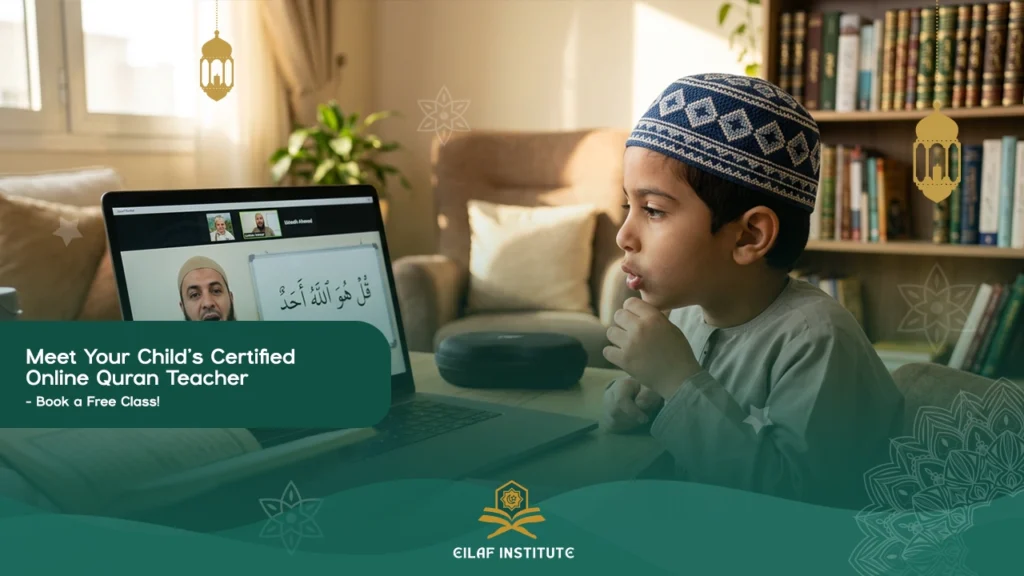
Teaching a child to recite the Quran correctly from a young age is a primary goal for many families, and a significant part of this success lies in how online Quran teachers help kids with pronunciation through specialized training and real-time feedback. Teachers can monitor a child’s exact mouth and tongue movements to ensure correct articulation by using high-definition audio and video. This modern approach offers a level of precision in religious education that crowded, traditional classrooms rarely match.
How Online Quran Classes Work for Children
These classes operate through synchronized live video platforms that connect a student directly with a professional tutor for one-on-one instruction. Instead of following a generic group pace, Online Quran Classes for Kids’ Pronunciation are tailored to the specific vocal capabilities and learning speed of the individual child.
Structured path
- Direct Interaction: The teacher recites a verse or a letter, and the child repeats it immediately, allowing for Live Quran Pronunciation Correction.
- Visual Demonstration: Tutors often use their cameras to show the exact position of the lips and tongue for difficult Arabic letters like ‘Dad’ (ض) or ‘Qaaf’ (ق).
- Digital Resources: Online Quran Tutors for Kids use digital versions of the Noorani Qaida or the Mushaf, which can be highlighted and annotated on the screen in real-time.
- Progress Tracking: Most platforms include digital dashboards where parents can see exactly which rules the child has mastered and which areas need more practice.
How Online Quran Teachers Help Kids with Pronunciation: Top 5 Tools
Teachers utilize a variety of digital tools that make Online Makhraj Correction for Kids more effective than traditional methods. These tools bridge the physical gap and ensure that the student hears and sees the correct way to recite every syllable.
- High-Definition Audio Gear: Quality microphones allow the teacher to hear subtle nuances in the child’s voice, catching small errors in Tajweed that might be missed in a noisy environment.
- Interactive Digital Whiteboards: Teachers use these to draw the shapes of letters and indicate where the sound should originate in the throat or mouth.
- Color-Coded Tajweed Software: This helps children visually distinguish between different rules, such as when to apply a nasal sound (Ghunnah) or when to stretch a vowel (Madd).
- Screen Annotation: Tutors can circle specific vowels or symbols on the child’s screen, focusing their attention on the exact spot that needs correction.
- Recording Features: Many Online Tajweed Classes for Children allow sessions to be recorded so that the child can listen back to the teacher’s correct pronunciation throughout the week.
The Benefits of Online Quran Classes Compared to Traditional Learning
The primary benefit of a Virtual Quran Teacher for Children is the elimination of environmental distractions and the ability to access world-class educators from home. Traditional settings often suffer from high student-to-teacher ratios, which means individual pronunciation errors can go unnoticed for years.
- Customized Focus: In a one-on-one online setting, the teacher’s entire focus is on your child’s voice, leading to much faster improvement in articulation.
- Safe and Comfortable Environment: Children often feel more confident practicing “strange” sounds in the privacy of their home rather than in front of a large group of peers.
- Access to Native Experts: You are not limited to local teachers; you can choose a tutor who is a native Arabic speaker and holds an Ijazah, ensuring the highest standard of Live Quran Pronunciation Correction.
- Consistency: Because there is no commute, classes are less likely to be missed due to weather or transportation issues, and a steady learning rhythm.
Read also about: What Is The Best Way To Read Quran?
What to Look for When Choosing an Online Quran Teacher
When selecting a tutor, you should prioritize their ability to simplify complex linguistic rules and their patience in working with young, developing voices. A great teacher is one who can make Online Makhraj Correction for Kids feel like an encouraging activity rather than a strict drill.
Key factors to consider include:
- Pedagogical Experience: Ensure the teacher has specific experience with children, as teaching phonetics to a child requires a different vocabulary than teaching an adult.
- Technical Proficiency: The teacher should be comfortable using digital tools and have a stable, high-quality internet connection to avoid audio lag.
- Language Skills: The tutor must be able to explain the Rules To Read the Quran clearly in a language the child understands fluently.
- Trial Sessions: Always look for a teacher who offers a trial class so you can observe how your child responds to their teaching style.
Why Eilaf101 Teachers Help Children Achieve Better Results
Eilaf101 employs a specialized curriculum that focuses on building a child’s phonetic foundation before moving to full-speed recitation. Our teachers are trained to use positive reinforcement, ensuring that every child feels capable of mastering even the most difficult Arabic sounds.
Our program is centered around reading the Quran, which is designed to take students from basic letter recognition to fluent reading with proper Tajweed. We focus on the Noorani Qaida as a primary tool because it provides the essential building blocks for all future Quranic studies.
By securing a spot in our Quran reading Course For kids, you provide your child with a direct path to eloquent and accurate recitation under the guidance of expert mentors. This investment in their early education ensures they never have to struggle with incorrect habits as they grow older.
At What Age Can Children Start Online Quran Classes?
Most children can start as early as five years old. At this age, their cognitive skills are developed enough to follow a teacher’s instructions through a screen, and their vocal flexibility is at its peak for learning new sounds.
How Long Does It Take to Improve Quran Pronunciation Online?
Visible improvement can often be heard within three to six months of consistent practice. However, mastering all the points of articulation and the complete set of Tajweed rules usually takes a year or more of regular study.
How Often Should Children Attend Online Tajweed Classes?
For the best results, children should attend classes two to three times a week. This frequency provides enough repetition to build muscle memory without overwhelming the child with too much information at once.